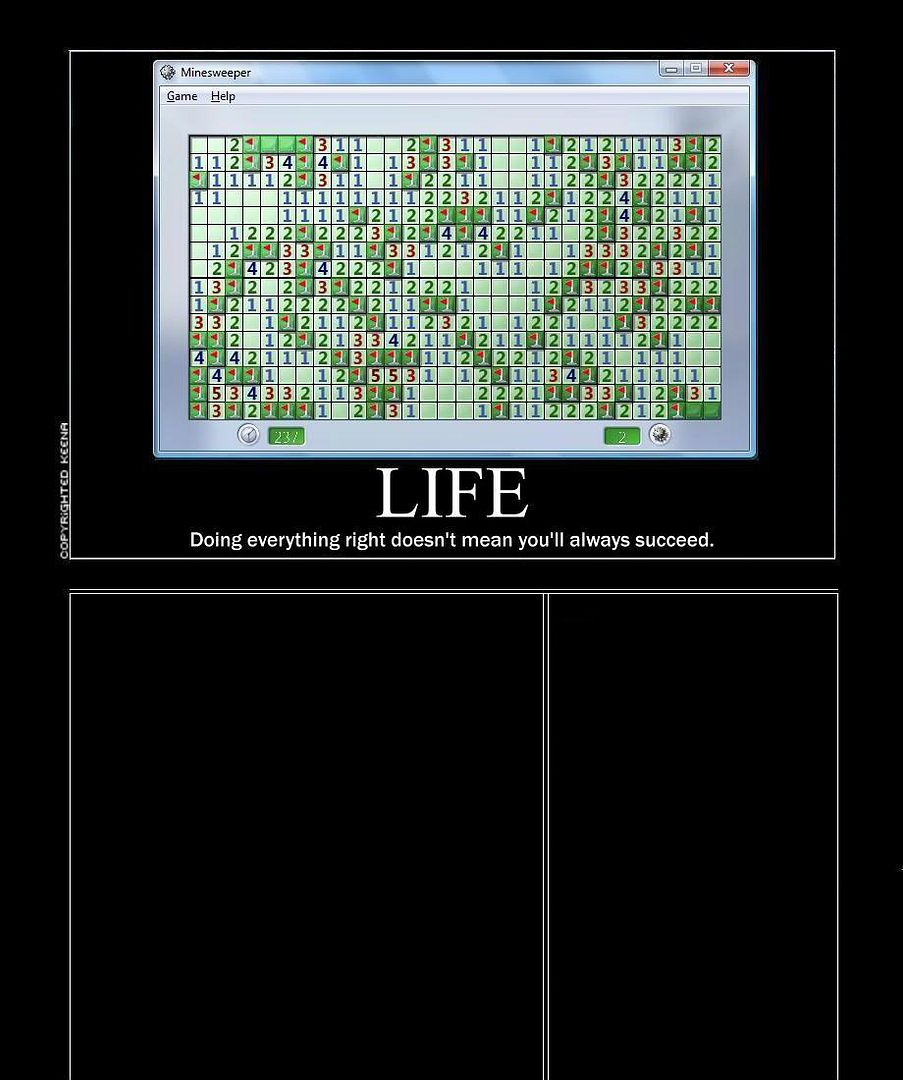
Reflecting. Why do I reflect? After all, what I do see only serves to make me more afraid of myself.
It is true, after all, that ignorance is really bliss. Or is it not? Perhaps it differs in the long run and in the short term.
Of course, it is subjective. It differs on a case-by-case basis. Remaining ignorant of the fact that you accidentally ate some ants along with that plate of rice is bliss. Remaining ignorant of the fact that the cook dug his nose and spat into the wok while frying your Char Kuay Teow is bliss. After all, knowing such things would only serve to distract you and perhaps make you uncomfortable, but ultimately have no effect on your well-being in the long run.
But on the other hand, ignorance may not be bliss. There are some people out there who are woefully ignorant of many matters in this world. Let's say, for example, that person A is so ignorant that he does not believe that humans have landed on the moon (yes, there are still plenty of such people in Singapore in this day and age). How would the knowledge, or lack thereof, of such a fact affect him? Perhaps it may not, for it is of no practical use. However, let us assume that one is ignorant of Newton's laws despite observing it in everyday life. This is what might happen:
So in the end, like most other arguments, whether ignorance is bliss or not is subjective. There are many cases where one would rather be ignorant. Not knowing for sure that that unknown substance you got on your shoe is dog poo is bliss. On the other hand, ignorance in many facts of life may prove to be detrimental to your life as a whole eventually.
And on a totally unrelated side note,
How many of you would live another life the same way you lived this?
Is it possible for one to live an entire life without regret.
Then again, regret is of course, subjective.
Different people can live through the same circumstances and have different opinions of the same performance.
Perhaps the happiest person in the world would regard everything in his life positively.
The ultimate optimist. One who takes every setback as another learning point. One who takes every failure as another way not to perform said act. One who takes every fall as another way to learn.
The thing is, does such a person exist? Who is this godly person who lives an entire life without regret? Is it possible that the lesser factors there are in one's life, the more easier it is to attain such happiness?
And thus brings me to the question: Are those who live in say, tribes, fufilling just enough to sustain their lives and having not much in the way of recreation, necessarily happier and more self-fufilled than those who live in the modern world?
Because their wants are limited, it is harder to fail to achieve their wants. Because their lives are simple, it is harder to make a mistake. The less steps you make in a game of chess, the less likely you are to expose weaknesses. Conversely, the better you are, the more advantageous it is to you to make more steps. But on the other hand, how many of us can treat life like a game of chess? How many of us can be confident of every step, every move, and live without regret?
Self-fufillment. Attainment.
And again I ponder.
Anonymity. It is much more powerful than one can imagine. Most humans in the modern world are your average, law-abiding citizen. Mostly nice people. Of course, there are exceptions. Such as me.
Let us now take a look at the online world. Let us focus on a specific community. Say, Youtube. Take a quick look at about 90% of the comments on the less famous videos. Why less famous? Because on the famous videos, most of the community are in consensus about how ownage it is, and generally negative comments will be shot down.
Most people are douchebags online. Behind the computer screen, there are uncountable assholes in the online world. Forums. Communities. The amount of shit people can spew are amazing. Shit that one would not spew in real life. As someone on a forum once put it: 90% of assholes you meet online would, under different circumstances, become friends with you if you had met in real life. Anonymity is dangerous.
And so. Are people inherently bad? Or good? Or a blank sheet? Are they, under the mask of anonymity, revealing their repressed unconscious thoughts online? Freudian theory. Unconscious thoughts. Perhaps anonymity works like hypnotism.
In crowds. In real life. When one is in a huge crowd. When one is anonymous. One does alot of things. Lynching. Vandalism. Many cases are recorded of huge crowds performing horrifying acts that no one would do had they been alone. Anonymity grants one freedom from the arm of the law. What would one do under such circumstances?
A tourist to Singapore once said that Singaporeans were unnaturally law-abiding. He observed that this was the case despite the conspicuous lack of policemen on the streets. Of course, this is probably by comparison to his own home country. So, we can assume from this point that Singaporeans are more law abiding than those of other countries.
But does it make Singaporeans any less of an asshole online? It is of my opinion that just about anybody who have played any online COMPETITIVE game with other, anonymonous Singaporeans will attest to the opposite. Of course, there are always nice people online, like me. Or maybe not.
DoTA. Left4Dead. Singaporeans are mostly assholes online. Arrogant, cocky, vulgar. An annoying tendancy to throw insults for the least likely of reasons. At least, that is what I perceive.
Some people do it on purpose for self-entertainment. Clarence Lim. In real life, those who know his or her intentions know that these people dont actually mean what they say. But for the receiver of such insults. Can one differentiate it? All insults look the same.
And so. Are Singaporeans really repressing their desires in their daily life? For that matter, are most people really doing the same? Probably yes. Which brings us back to... the danger of anonymity. The dangers of what one can or might do when outside of the arm of law.